
Advanced Wallet Tracking: Find Your Own Smart Money Wallets
In 3.2 we covered the basics of tracking. Now let's practice: how to find wallets worth tracking, on your own, without buying a "wallet list" from someone else.
This material is based on a thread by our friend Seona, which I tidied up and added to so it's easy for beginners to follow.

Why Find Your Own Wallets?
- Wallets that get sold to lots of people are usually already followed by a crowd. The moment that wallet buys, all its followers buy in the same second, so your price gets worse.
- You don't know whether the wallet is actually good, or only looked good when it was being sold.
- When you find them yourself, you understand why a wallet made your list. That's worth far more than just having its address.
Here we use GMGN, because its interface is nice for screening wallets and the data is complete.
Short Video
A 28-second video from Seona: open a token's chart, click the before the , then scroll the trade history for that candle.
Step 1: Find a Token That "Woke Up"
The best moment to hunt for wallets: a token that was / quiet for a long time, then suddenly pumped hard.
Why? The ones who bought before the pump are often wallets that knew something first, whether from research, info, or instinct. They had a reason to get in early, and that's what we want to learn.
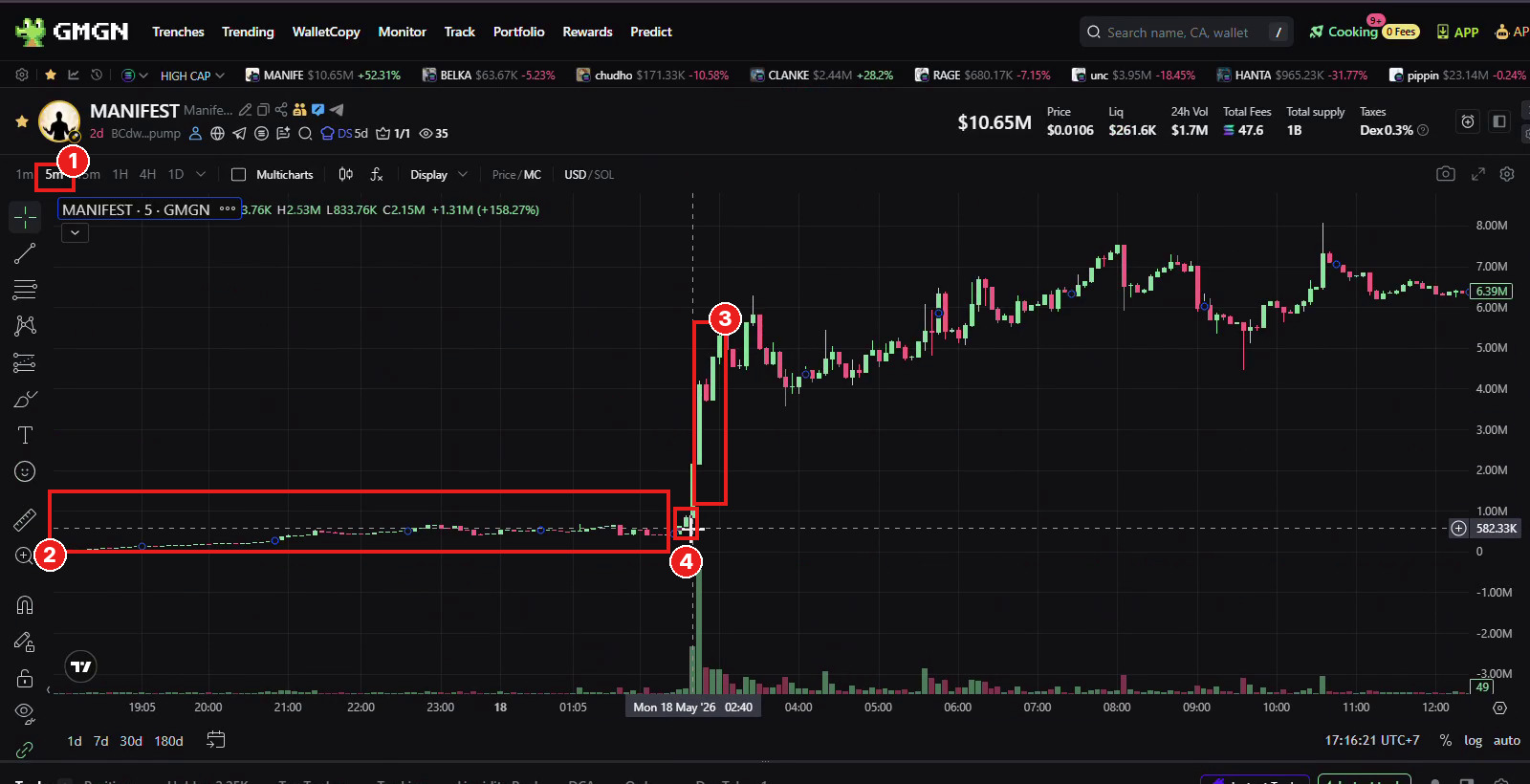
Step 2: Click the Candle Before the Pump
- Use the 1m or 5m timeframe. The smaller the timeframe, the fewer trades per candle, so it's easier to filter.
- Click the candle before the pump. The Trades tab under the chart automatically shows only the transactions within that candle's time range.
- Use the ← → arrow buttons to move to the candle before/after. Wallets that got in 1 to 3 candles before the pump are worth checking too.
- Click Reset to show all trades again.
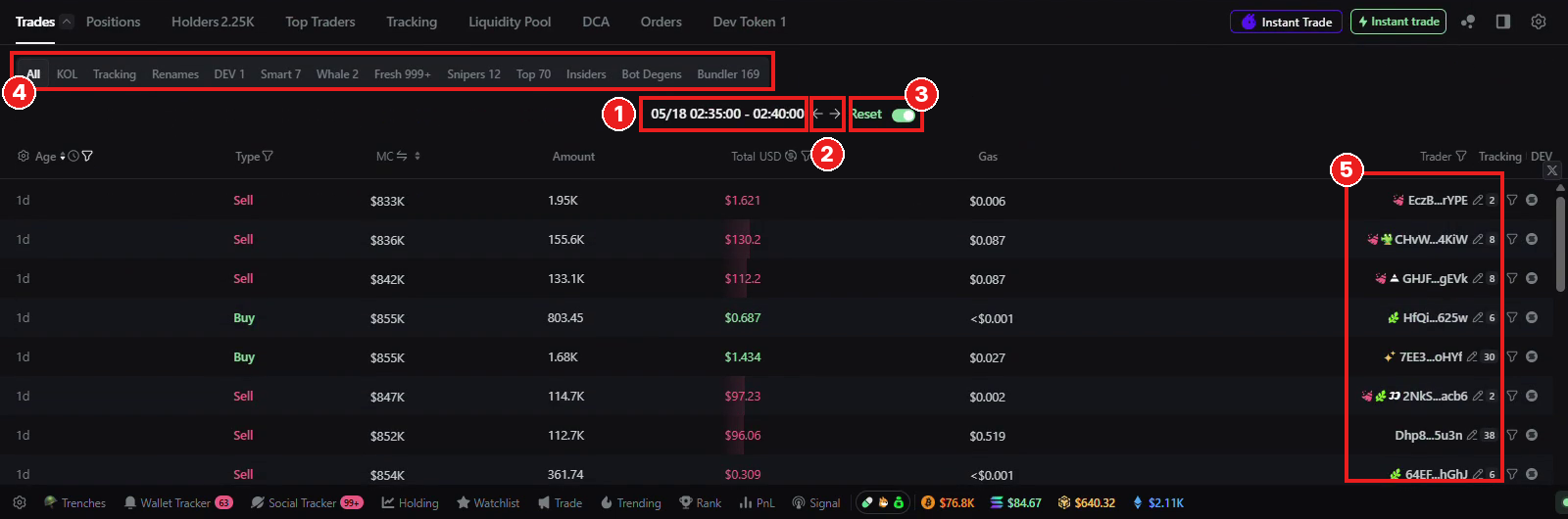
Step 3: Filter for Interesting Wallets
Scroll through the trade list, then focus on:
- Buys of a decent size. On GMGN, the Total USD column has a green bar for buys, and the longer the bar, the bigger the amount. So you can see who got in seriously.
- Wallets that show up several times, for example buying a few times in the candles before the pump.
- Note down a few candidates first, don't follow them right away. Check them first in Step 4.
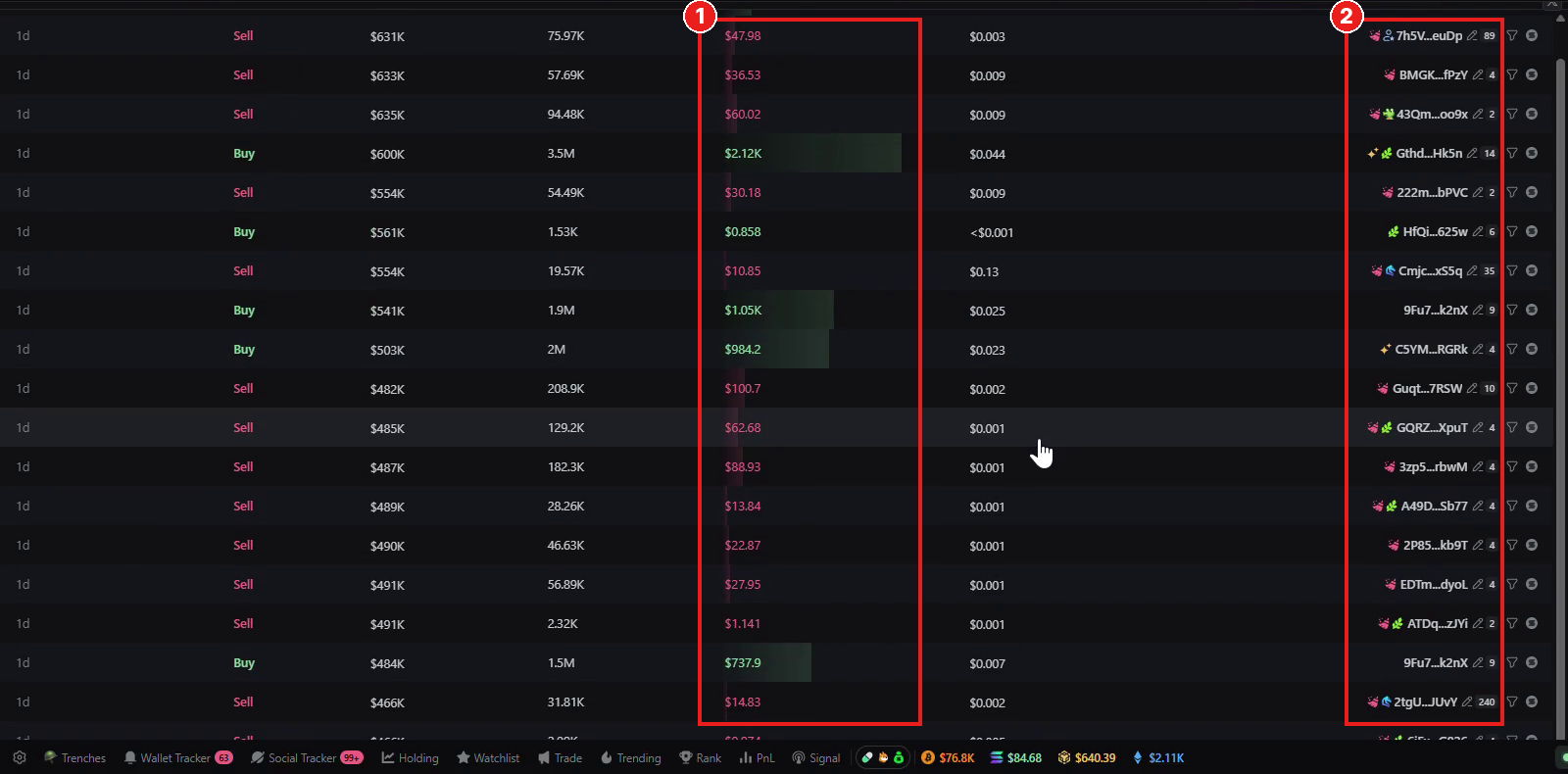
Step 4: Check the Wallet First
Click a candidate wallet's address to open its wallet page on GMGN. Here's what you need to look at:
| What to look at | What it means | What you want |
|---|---|---|
| 7D / 30D PnL | Profit/loss over the last 7 and 30 days | Consistently green, not just one lucky hit |
| The percentage of trades in profit | High is good, but it doesn't count the size of profits vs losses. A high win rate can still lose money if the losses are big. Don't fixate on WR: what matters most is that you understand the wallet's play through your own analysis | |
| Total PnL | Total profit/loss | The profit doesn't come from just 1 token |
| TXs (green buys / red sells) | Number of transactions | Too many trades per day is usually a bot |
| AVG Duration | Average holding time | Fits your style. Holding for only seconds = hard (or even impossible) to follow |
| check | Checks for suspicious wallets | See the explanation below |
check on the GMGN wallet page:
- : how many blacklist/ tokens it has bought. If it's a lot, it could be a cabal team's wallet.
- Didn't buy: tokens in the wallet that it didn't buy, meaning they were sent from another wallet. If it's a lot, this wallet may be an insider/ getting an allocation. It's the same idea as the Phishing metric in lesson 2.13 (tokens that came in through transfers, marked with a red fishing hook icon in the tab): 2.13 Phishing (GMGN Metric): Supply from Transfers, Not Buys.
- Sold > Bought: sold more than it bought. That means it got tokens from somewhere else.
- Buy/Sell within 10 secs: buying and selling within 10 seconds. It could be a bot, or a wallet deliberately "baiting" copy traders.
A jeeter example: the wallet below looks active, but it only holds for seconds and mostly loses. A wallet like this is not worth tracking, because you won't have time to follow it and the results are bad anyway.
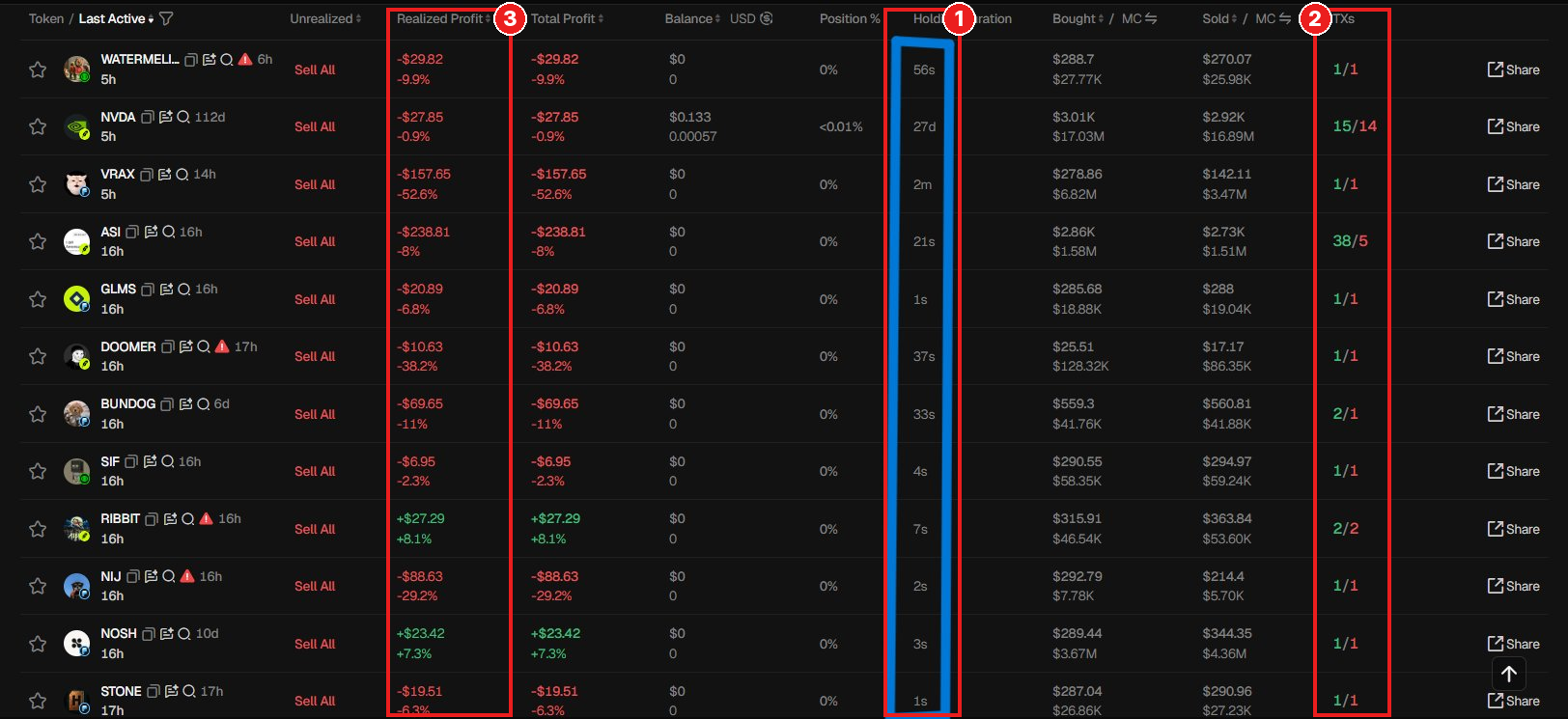
Spotting Multi Wallets
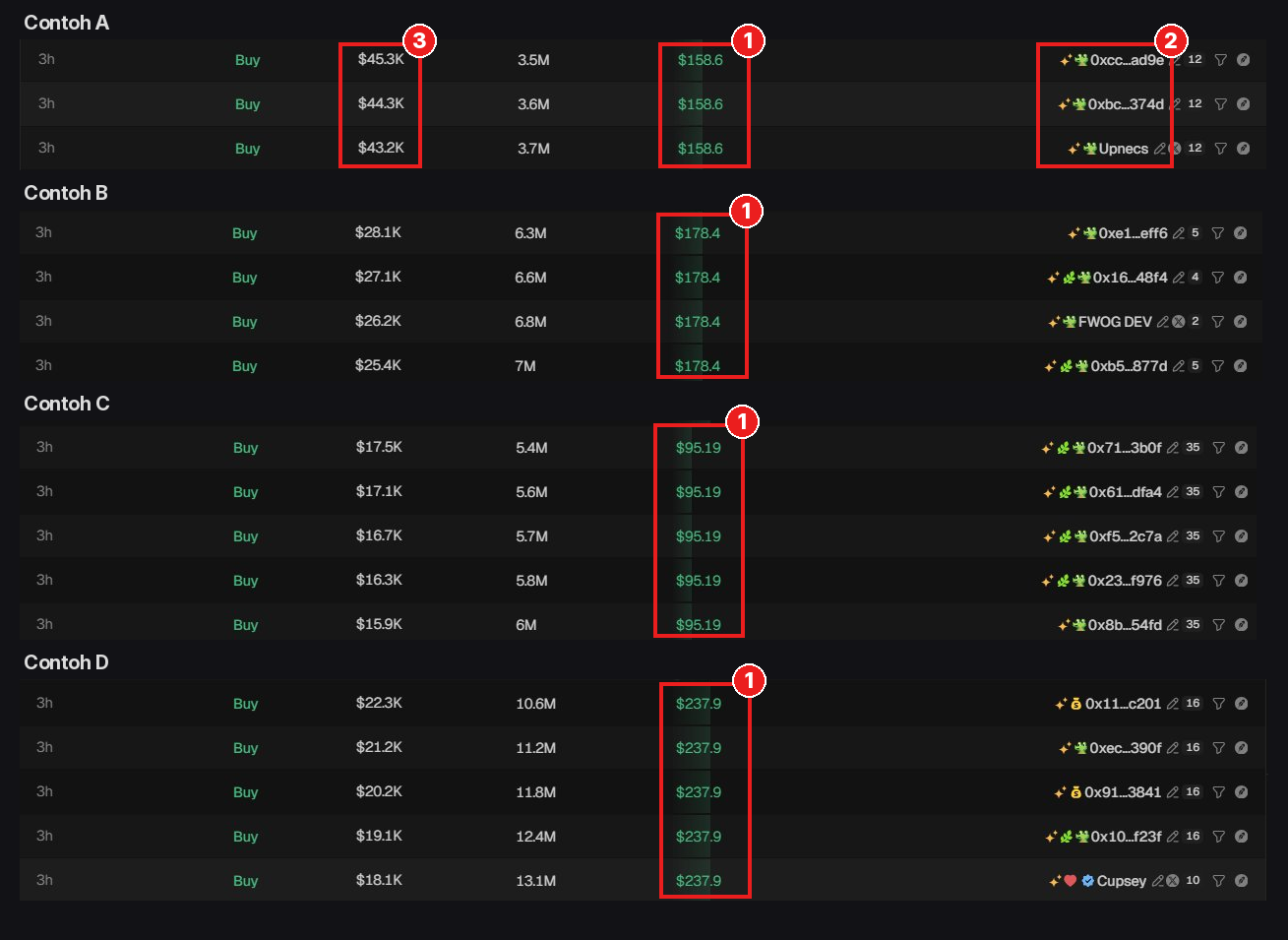
While hunting, you'll sometimes find several buys with exactly the same amount that show up in a row at the same time, but from different wallets. Most likely that's the same person using lots of wallets. This is called a multi wallet.
How to spot it:
- Exactly the same Total USD (for example 3 to 5 buys of $158.6 each).
- They show up in a row at the same time.
- The goes up step by step, meaning the buys came one after another.
- The wallet addresses are all different.
Why do people use multi wallets? So the they hold doesn't pile up in one wallet. Picture it: if you saw one wallet holding 8% of supply, you'd definitely hesitate to enter. But if that 8% is split across 5 wallets (~1.6% each), the looks much smaller.
Why does this matter to you?
- Top 10 / holders can look healthier than they really are. Supply that's actually held by one person looks spread out (remember 2.4 ).
- If that one person sells everything, the effect is the same as one whale dumping. Check the in 2.9 , and compare it with the pattern in 2.8 Bundler.
- For wallet tracking: if you follow one of those wallets, you're really following the same person. So don't count them as "lots of agreeing".
A multi wallet is a signal, not a verdict. There are also regular traders who use several wallets, or bots that happen to use the same amount. Use it to raise your guard, then ask yourself: "am I ready if all these wallets sell together?"
Step 5: Follow & Name It
If the wallet check looks good:
- On the wallet page, click Follow. The wallet goes into the list you track. This feature needs you to log in to GMGN first.
- Click the button next to the wallet name to add a note/name (for example "pre-pump MANIFEST"). So you remember why you're tracking that wallet.
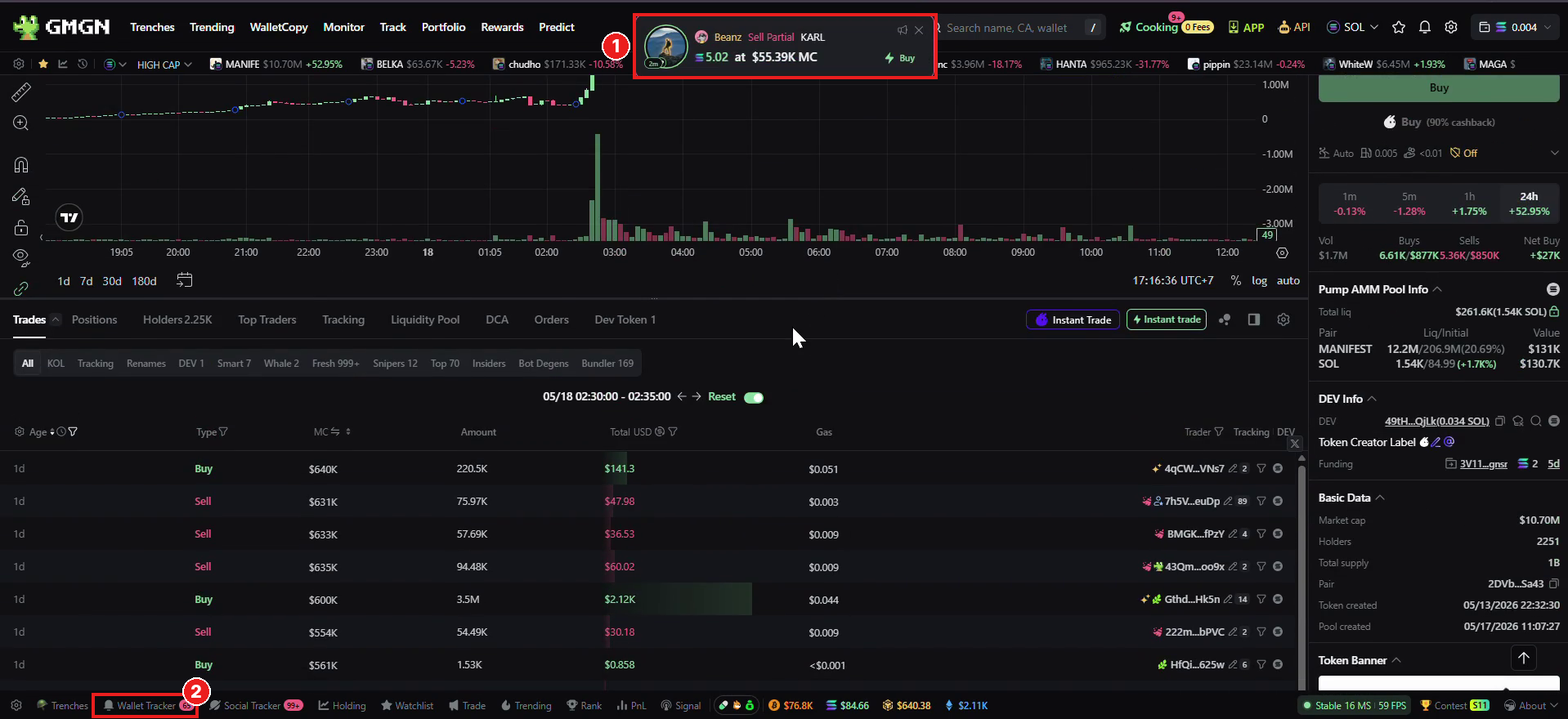
- All activity from wallets you follow can be seen in the Wallet Tracker tab (the bottom bar of GMGN on the web). In the GMGN app: the Track tab at the bottom.
- Turn on notifications (GMGN web notifications, push notifications in the app, or the Telegram Alert Bot) so you hear about every buy/sell from that wallet.
Review regularly: every 1 to 2 weeks, check the wallets on your list again. If one's performance drops or it starts acting strange, just unfollow it.
Risks & Limits
- Copying a wallet ≠ guaranteed profit. Even good wallets can lose, and they can usually absorb losses that would hurt you too much.
- You're always slower than the wallet you follow, so you get a worse price.
- Insiders, devs, and bundlers can look like smart money. They "buy before the pump" because they're the ones making the pump. That's why Step 4 is a must.
- A wallet owner who knows they're being tracked can deliberately buy, then sell to their followers.
- A wallet notification is an idea, not a buy signal. After a ping, always do further analysis: check the token using Chapter 2 and the 2.14 checklist, and match it to your playstyle. Don't just in blindly.
- Two people tracking the same wallet can get very different results. What matters most is each person's further analysis and skill, not the wallet list.
Remember: Look for the Smallest Possible Risk
In the market, our goal isn't to catch every pump. Our goal is to take the smallest possible risk. Don't let greed drive you.
Wallet tracking is the same:
- Remember RR > WR: set how much you're ready to lose vs your target on each trade (lesson 3.3).
- Don't into every buy. A wallet you track might buy 20 tokens a day. You don't have to follow all of them.
- Pick the ones that make sense for you: the token check comes out low risk, the position size fits your money, and you know when you want to get out.
- Missing one is fine. There'll be other tokens tomorrow. What's dangerous is getting in out of panic about missing out.
Summary
- Find a token that was sideways for a long time and then suddenly pumped, click the candle before the pump on the 1m/5m timeframe, then filter the wallets that bought there.
- Check the wallet page first: 7D/30D PnL, win rate, Total PnL, holding time, and the phishing check.
- Watch out for multi wallets. Follow the ones whose check looks good, name them, and review every 1 to 2 weeks.
Common mistakes
- Following candidates right away without Step 4.
- Counting multi wallets as "lots of smart money agreeing".
- FOMOing into every buy from the wallets you track.
In the market, what we're after is the smallest possible risk. Missing one entry is fine, don't follow every buy out of greed.
References:
- Wallet tracking thread by @Seonasol
- Multi wallet post by @Seonasol
- GMGN Docs: Wallet detail page
- GMGN Docs: Wallet Tracker & Alert
Next up, lesson 3.6: Entry Tips: Buying on Unbonded Lowcap Tokens.
Not financial advice.
Progress is saved in this browser.