
Must-Know Degen Terms
Joined a degen group but can't follow chats like "CA?", "it bonded", "dev rugged"? This lesson is a short dictionary of the most common terms, so you don't misread things and can follow the next lessons.

Why learn the terms?
- A lot of decisions are made fast in groups. Misread one term and you can buy the wrong thing.
- These terms show up constantly on terminals like GMGN, Axiom, and Photon.
- Once you know the terms, you can follow other people's analysis and you're harder to fool.
How to read this: term → meaning → example.
Coin Basics
- Degen: short for degenerate. What people call someone who's willing to play very risky coins for a shot at big gains.
Example: "I'm degening" = I'm playing a new coin that could go 10x, but could also go to zero.
- Memecoin: a coin whose price moves because people are talking about it (hype), not because there's a product or business behind it. Indonesian degens call these "micin".
Example: a dog or cat coin that goes viral on X.
- CA (Contract Address): a coin's unique address, a long string of letters and numbers. Anyone can copy a name and logo, but not the CA.
Example: like a national ID number. Lots of people are named "John", but each ID number belongs to only one person.
- Supply: the total number of coins that exist.
Example: if there are 1 billion coins in total, the supply is 1 billion.
- MC (Market Cap): a coin's "total value", the price of one coin times the number of coins in circulation.
Example: a price of $0.001 × 1 billion coins = MC $1M. Going to MC $2M means the price doubled.
- Liquidity (Liq): the funds (token + SOL) sitting in the coin's pool. This pool is what lets people buy and sell.
Example: a small pool is like a corner shop with very little change in the till. One big purchase and the price jumps.
- Volume (Vol): the total value bought and sold over a period (for example, 24 hours).
Example: a big "24h Vol" = the coin is being traded a lot right now.
- Holder: a wallet that currently holds the coin.
Example: 500 holders = the coin is held by 500 wallets.
- Dev: the person or team that created the coin.
Example: "dev sold" = the dev sold their own coins, which usually pushes the price down.
- DEX: a place to buy and sell coins straight from your wallet, with no middleman like Pintu.
Example: PumpSwap and Raydium are DEXes on the Solana network.
- Meteora DLMM: a type of liquidity pool on the Meteora DEX. Tokens launched on pump.fun can have a pool here, not only on PumpSwap.
Example: the DOPE pool is on Meteora DLMM, so its Burnt number is still read straight from the metrics card (lesson 2.15).

Token header on GMGN (example: MACARON, a pump.fun token): ① MC $2.94K (the header only shows the number, without the "MC" label), ② Price, ③ Liq $6.28K, ④ 24h Vol $3.68K, ⑤ Total Fees 0.053 SOL, ⑥ Total supply 1B. GMGN screenshot (checked Oct 18, 2026, 15:02 WIB, logged out); the numbers were live at the time and will keep changing. Token is only an example, not a recommendation.
</image>
pump.fun Terms
- Bonding curve: the first stage of a new coin on pump.fun. The price is set automatically: the more people buy, the pricier it gets; the more people sell, the cheaper it gets.
Example: "B. Curve 1.34%" on GMGN means this first stage is only filled a tiny bit (1.34%).

Same token (MACARON): red box on B. Curve 1.34%. Its bonding curve is only 1.34% full, so this token is still on pump.fun and hasn't migrated yet. GMGN screenshot (checked Oct 18, 2026, 15:02 WIB, logged out); the numbers were live at the time and will keep changing. Token is only an example, not a recommendation.
</image>
- Bond / graduate / migrate: when that first stage fills up (100%), the coin "graduates" and moves to PumpSwap, the DEX owned by pump.fun.
Example: like a small business that starts out selling at a market stall, then moves into its own shop once it takes off.
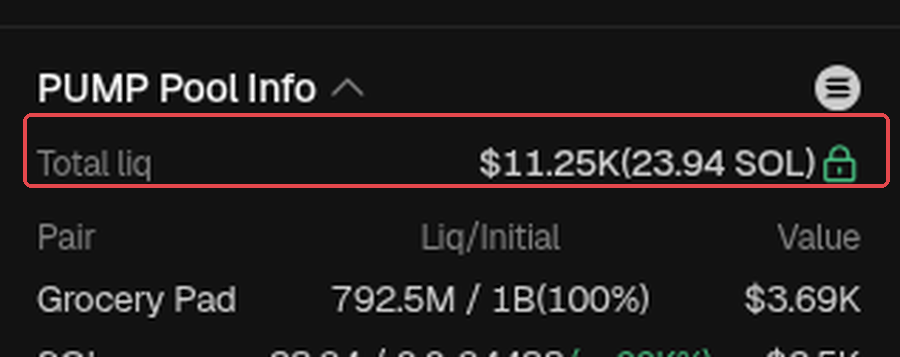
Another example (token Grocery Pad) still in the bonding stage: red box on Total liq in the PUMP Pool Info panel ($11.25K / 23.94 SOL). After it bonds, the token moves to a PumpSwap pool. GMGN screenshot (Oct 2026). Token is only an example, not a recommendation.
</image>
- Trenches: the "zone" of coins that are only minutes or hours old. The earliest and the riskiest.
Example: "playing the trenches" = buying freshly created coins before many people know about them.
- New pair: a coin that was just created or just got a pool, usually only minutes old.
Example: a coin that launched 5 minutes ago still counts as a new pair. The busiest and the riskiest.
Trading
- Entry: the moment you buy.
Example: "entry at MC 100K" = bought when the coin's MC was about 100 thousand dollars.
- TP (Take Profit): selling some or all of your coins while you're in profit, so the profit is actually secured.
Example: your position doubles and you sell half. That's TP.
- SL / Cut loss: selling while you're down, so the loss doesn't get bigger.
- WR (Win Rate): the percentage of your trades that are profitable. Example: 6 out of 10 trades in profit = 60% WR. A high WR doesn't mean you're making money if your losses are big (lesson 3.3).
- RR (Risk/Reward): how much you could lose vs. how much you could gain on one trade. Example: risking a 20% loss for a 60% profit target = 1:3 RR. In this course: RR matters more than WR (lesson 3.3).
Example: the price drops 30% from your entry, so you sell and take a small loss instead of waiting for it to hit zero.
- x (2x, 10x): how many times the price has multiplied from where you bought.
Example: you buy 0.1 SOL worth and it grows to 0.2 SOL = 2x.
- ATH (All Time High): the highest price or MC the coin has ever reached.
Example: "already down 80% from ATH" = the price is far below its peak.
- Pump: a sharp price rise in a short time.
Example: the price triples in 10 minutes.
- Dump: a sharp price drop in a short time.
Example: lots of people sell at once and the price halves within minutes.
- Slippage: the difference between the price when you click and the price when the transaction actually goes through. In your settings, slippage is the maximum difference you allow; if it goes past that, the transaction is canceled.
Example: 10% slippage = you accept a price up to 10% worse than what's on screen.
- Priority fee: a small extra fee so your transaction gets processed ahead of the queue.
Example: like paying for express shipping so your package gets delivered first.
- Tip (Jito tip): an extra fee on top of the priority fee, paid to a special node/validator (Jito, for example) so your transaction lands faster.
Example: on GMGN, priority fee and tip fee are set separately; on Frontrun, Auto Fee handles both automatically (lesson 1.5).
- Auto Fee: a feature that sets the priority fee/tip automatically based on network conditions.
Example: turn on Auto Fee in Frontrun, then set a maximum so you don't overpay on fees (lesson 1.5).
- Price impact: how much your own transaction moves the price. The smaller the liquidity and the bigger the order, the bigger the price impact.
Example: buying 5 SOL in a pool with only 20 SOL moves the price far more than buying 0.1 SOL.
- Sandwich attack (MEV): a bot sees your transaction, buys right before you, then sells right after you. You get a worse price.
Example: your slippage is 50%, and a bot exploits that gap. Anti-MEV features help prevent this.
- Ape: buying fast without checking much.
Example: you see a coin pumping in a group and buy right away without checking the CA. It often ends badly.
- FOMO: fear of missing out on gains, so you rush to buy.
Example: a coin is already up 10x and you still buy because you're scared it'll keep going. You often end up buying the top.
- Jeet: a nickname for someone who sells very fast, often for a tiny profit.
Example: buys, the price goes up a little, sells everything within seconds.
- Bag / bagholder: someone still holding a coin whose price has crashed.
Example: bought the top, the price fell 90%, still hasn't sold. That's a bagholder.
- Candle: one bar on a chart showing the open, close, high, and low price over one time period. The body is usually green when the price went up and red when it went down; the thin lines above/below are called wicks.
Example: a green candle with a long upper wick = the price shot up, then came back down before the candle closed (lesson 3.11).
- Timeframe: the time period each candle covers, like 1m, 5m, or 1h.
Example: a 1m timeframe = each candle represents 1 minute (lessons 3.5, 3.11).
- Support / Resistance: support = a price area that gets touched several times and bounces up (a "floor"). Resistance = a price area that gets touched several times and gets rejected back down (a "ceiling").
Example: the price bounces three times around MC 15K = support around 15K (lessons 3.6, 3.11).
- Double bottom: the price drops to roughly the same area twice and bounces. Often read as support, but it can still break.
Example: the DOPE chart in lesson 3.11, bouncing twice around MC 2.9M.
- Volume spike: a jump in volume, a volume bar much taller than usual. A sign of big activity, buying or selling.
Example: the tall volume bars under the DOPE chart (lesson 3.11). Check who's trading in the Trades tab.
- Sideways: the price moves flat within a narrow range for quite a while.
Example: a token that goes sideways for a long time and then suddenly pumps is said to "wake up" (lesson 3.5).
- Position sizing: deciding how much of your capital goes into one trade.
Example (illustration): 2 SOL of capital, 5% per trade = a 0.1 SOL position (lesson 3.10).
- Initials / free ride: taking out your initial capital (initials) after the price goes up, so the rest rides for free (free ride).
Example: you buy 0.1 SOL worth, it grows to 0.2 SOL, you sell half = your initial capital is back, before fees (lessons 3.3, 3.9).
- Averaging down: buying more at a lower price to bring your average price down.
Example: a token already rugged and you buy more "to lower your average". This course says to avoid that habit (lesson 2.12).
- Revenge trade: jumping straight back in after a loss to win the money back, often with a bigger position.
Example: right after losing 0.1 SOL, you put 0.3 SOL into another token without running the checklist (lesson 3.12).
Wallet & Security
- Wallet: where your coins are stored, like a bank account for crypto. It has its own address for receiving transfers.
Example: the GMGN wallet from lesson 1.4.
- Network: the "route" a coin is sent on. You have to send on the same network as the receiver.
Example: sending SOL from Pintu to GMGN uses the Solana network. Wrong network = your funds can be lost.
- Private key: your wallet's secret key. Anyone who has it can move everything out of the wallet.
Example: like your PIN and ATM card in one. Never give it to anyone.
- Seed phrase (recovery phrase): 12 or 24 secret words used to restore a wallet. Just as dangerous as a private key if it leaks.
Example: wallets like Phantom give you a seed phrase when you create a new wallet.
- 2FA (Google Authenticator): a 6-digit code on your phone that keeps changing, used as a second key.
Example: on GMGN, 2FA is used when you bind security and set up your whitelist.
- Whitelist: a list of destination addresses you've approved. Withdrawals from GMGN can only go to addresses on this list.
Example: your Pintu SOL address goes on the whitelist (lesson 1.6).
- Phishing: scams using fake links, sites, or messages that look like the real thing, to steal your account or private key.
Example: a fake site whose name is one letter off from GMGN asks you to log in. Always open sites from a bookmark (lesson 1.4, Account Security).
Not the same as the Phishing number on GMGN's metrics card: that's a metric, not a fake link. See the term Phishing (GMGN metric) below and lesson 2.13.
Coin Safety Checks
- No Mint / Mint disabled: the dev can no longer mint (create) new coins.
Example: if minting is still on, the dev can create millions of new coins and sell them, and your price crashes.
- Blacklist / Freeze: the dev's ability to freeze certain wallets so they can't sell.
Example: you buy, then your wallet gets frozen. You're holding the coins but can't sell them.
- LP Burnt: the liquidity proof tokens (LP) have been burned, so the dev can't pull the funds out of the pool.
Example: like a vault whose key has been thrown away, so nobody can take what's inside.
Note: a pump.fun token still on the bonding curve has no LP yet; after it bonds to PumpSwap, its LP is burned automatically (lesson 2.3).
- Locked vs Burnt: Locked LP = locked until a certain time, and can be unlocked later. Burnt LP = burned for good, nobody can take it.
Example: locked is like a vault on a timer, burnt is like throwing the key away (lesson 2.3).
- Top 10 Holders: the percentage of coins held by the 10 biggest wallets.
Example: if 10 wallets hold most of the coins, they can crash the price by selling together. A red Top 10 (above 30%) is riskier, but it's not an absolute rule (the author's experience).
- Dev Supply: the percentage of coins held by the dev's wallet.
Example: the bigger the dev's share, the bigger the impact if the dev sells. But (the author's experience) a dev sell on a meme coin usually isn't a big deal; on a tech coin it's more often a red flag. Look at the context (lesson 2.5).
- Serial launcher: a dev who creates a huge number of tokens, most of which never migrate.
Example: the DOPE dev has created 4,108 tokens, and only 22 migrated (0.54%). Higher risk, not a prediction (lessons 2.5, 2.15).
- Funding / TF Amount: a column in GMGN's Holders tab showing where each wallet first got its SOL from (for example Binance, Bitget, or another wallet), how long ago, and how much (TF Amount).
Example: varied sources and old wallets = normal. Many top holders funded from the same wallet, at almost the same minute, with similar amounts = suspect one person using many wallets (lesson 2.6).
- Fresh wallet: a newly created wallet. GMGN's Holders tab marks it with a green leaf icon.
Example: lots of top holders are fresh wallets = check their funding, it could be one person using many new wallets (lesson 2.13).
- Sniper: a wallet (usually a bot) that buys in the very first seconds after a coin is created.
Example: a new coin is born and within seconds some wallets have bought a lot. They often sell fast. But lots of snipers doesn't automatically mean danger; sometimes the token still runs (the author's experience).
- Bundler: many wallets buying together in one bundle of transactions, usually controlled by one party to make ownership look spread out.
Example: 20 wallets buy at the exact same moment the coin is born, with the same fee and the same amount. It looks like lots of people, but it could be one. Bundlers aren't automatically bad: some hold the floor, some nuke (sell all at once). The Bundler % can also be inflated because bots buying in the same block get flagged too, so treat it as a signal, not a verdict (lesson 2.8).
- Bubblemaps: a bubble view showing which wallets are connected to each other (have sent funds to each other).
Example: lots of bubbles linked together = possibly held by the same person. Rough guide (the author's estimate): a cluster <5% is lower risk, 5 to 10% be careful, >10% high risk.
- Cluster: a group of wallets connected on the bubble map, usually shown in the same color. Wallets get flagged as a cluster if they've transferred to each other and then bought the same token, even if they have different owners. So a cluster isn't necessarily one person (lesson 2.9).
Example: 5 connected red bubbles = one cluster. Add up their percentages to see how much that group holds (lesson 2.9).
- Total Fee: the total fees (in SOL) paid by everyone who has traded the coin. Harder to fake than volume, because every transaction pays a fee.
Example: high MC but a small Total Fee = suspect the price is being moved by only a few wallets (covered in lesson 2.10). Exception: on a freshly launched new pair with big volume, this guide sometimes doesn't apply yet.
- Dex Paid: the team has paid to set up the coin's profile (logo, links) on DexScreener. It's no guarantee the risk is low.
Example: it's like buying an ad. Scammers can pay too. On GMGN, paid = an amount shows up (for example $299), not paid = Unpaid. The DS badge means Dev Sell, not DexScreener.
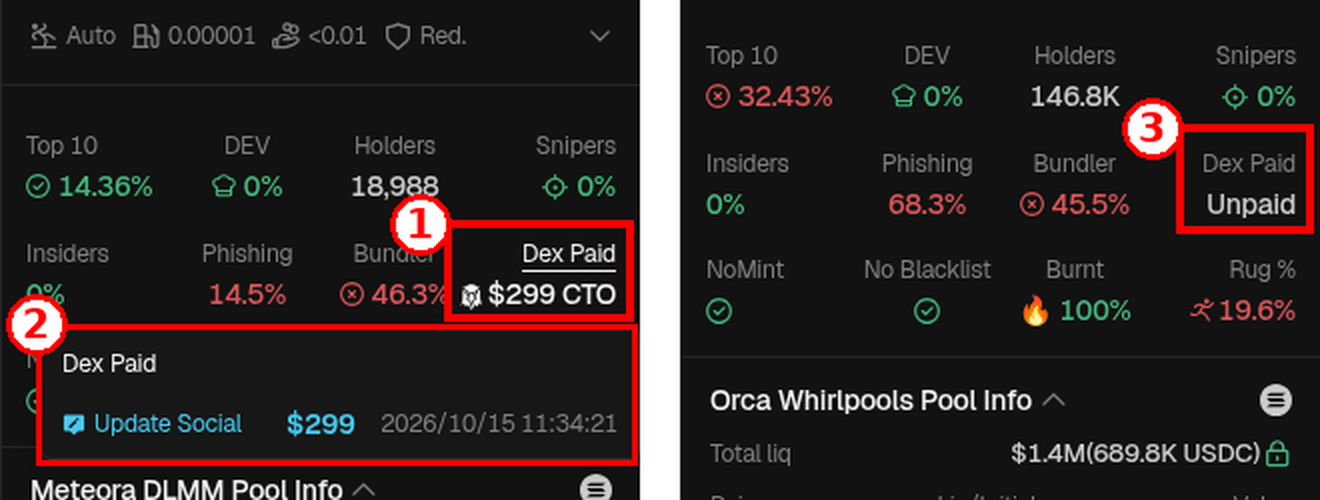
The Dex Paid column on GMGN: ① amount paid, ② details on hover, ③ Unpaid. (Screenshot: GMGN)
</image>
- Insider: a wallet suspected of belonging to an insider or someone tied to the team, holding the coin from the start.
Example: a wallet that bought before the coin was announced to the public.
- Phishing (GMGN metric): the percentage of supply held by wallets that got the token through a transfer, not a buy. It can be from an airdrop or team allocation, or an insider hiding supply.
Example: Phishing 6.9% = about 6.9% of the supply sits in wallets that never bought. A signal to check, not a verdict (lesson 2.13).
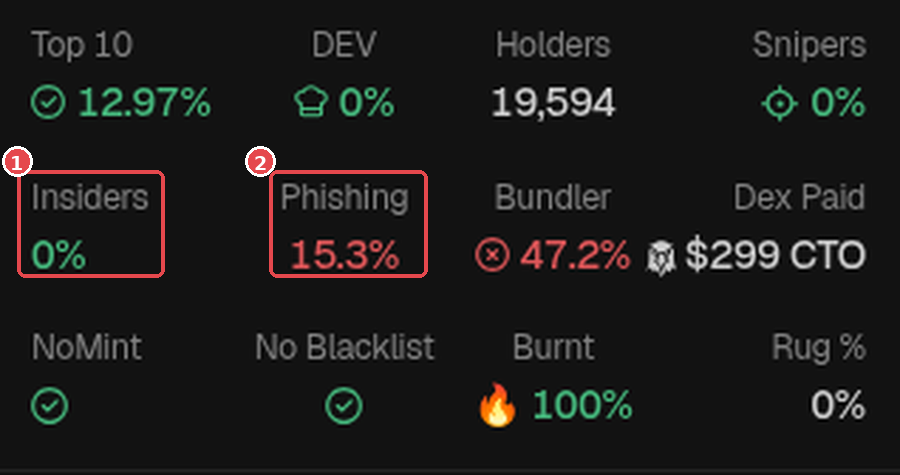
GMGN audit panel (example token FTR): ① Insiders 0%, ② Phishing 15.3%. The rest: Top 10, DEV, Holders, Snipers, Bundler, Dex Paid, NoMint, No Blacklist, Burnt, Rug %. GMGN screenshot (Oct 2026). Token is only an example, not a recommendation.
</image>
Red Flags
Red flag = a sign of higher risk, not a price prediction. Tokens with red flags sometimes still pump, and tokens without red flags can still dump.
- Rug / rugpull: the dev or insiders sell massively or pull the liquidity from the pool, then run. The price collapses.
Example: a coin keeps going up, then suddenly drops 90% in one minute and the dev disappears.
- Honeypot: a coin you can buy but can't sell.
Example: like a trap: money can go in, but it can't come out.
- Rug %: GMGN's estimate of the chance a token gets rugged. According to GMGN Docs, it's calculated from the holders: the more holders who often buy rug tokens, the higher the number.
Example: a high Rug % = be extra careful. It's only an estimate, not a verdict (lesson 2.12).
- RugCheck: a Solana token checking site outside GMGN. It gives a summary score plus details like insider networks.
Example: RugCheck says "No risks found" but flags 4 insider networks on HeyGrok, while GMGN shows Insiders 0% (lesson 2.16).
- Cross-check: comparing data from several tabs or tools before drawing a conclusion.
Example: the Bundler number on the metrics card gets checked again in the Trades tab, Bubblemaps, and Funding (lessons 2.8, 2.16).
- Wash trading / staircase chart: buying and selling back and forth by many wallets (bots) or even a single wallet, to make the volume look busy.
Example: a chart rising neatly like a staircase with no real pullbacks = suspect fake volume (lesson 2.12).
Community
- Shill: promoting a coin, usually to get other people to buy.
Example: an account that keeps posting "this coin will 100x for sure!"
- Call: a buy recommendation from a person or group.
Example: "called at MC 50K" = the group suggested buying when the MC was 50 thousand dollars.
- KOL: a crypto influencer who often posts calls.
Example: an X account with lots of followers that often shares CAs.
- Smart money: wallets considered to profit often, which other people tend to follow.
Example: you watch these wallets to see what coins they buy (covered in lessons 3.2 and 3.5).
- CTO (Community Takeover): the community takes over a coin after the dev runs, and keeps promoting it themselves.
Example: the dev rugs, but holders start a new group and X account to bring the coin back to life.
- NFA / DYOR: Not Financial Advice / Do Your Own Research.
Example: "NFA, DYOR" at the end of a call = the responsibility for buying is yours.
Summary
- This page is a dictionary of terms that will keep coming up in the next lessons. No need to memorize everything now: bookmark it and come back when a term confuses you.
- Anyone can copy a coin's name and logo, but not its CA. Memorize the terms if you like, but you still have to check the CA.
- Shills, calls, and KOLs are other people's promotions or recommendations. "NFA, DYOR" means the responsibility for buying is yours.
Common mistakes
- Buying a coin based only on its name or logo without checking the CA.
- Jumping on a "100x for sure" call or shill without checking yourself.
- Misreading one term in a group, then buying the wrong thing.
Knowing the terms makes you harder to trap. The goal stays the same: the smallest possible risk, not a moment of greed.
Next up, lesson 1.8: Tech Tokens (ICM/Utility) vs Meme.
Not financial advice.
Progress is saved in this browser.