
Money Management & When to Take Profit
Lots of people can find good tokens, but still get wiped out because they manage their money badly or never . This lesson covers how to manage your money and plan your take profit.

Why does money management matter?
- With , a token can drop to almost zero within minutes. If all your money is in it, it's over.
- Profit on the screen isn't profit until you sell.
- With managed money, you can keep playing even after a few losses in a row.
Basic money management principles
- Keep your money separate from your living money and savings.
- Limit the size per trade. Set a maximum percentage of your money for one token. Lots of traders use a small portion per trade so that one doesn't wipe out everything. The exact number is a personal choice, not a rule.
- Limit how many positions you have open at once, so you can still keep an eye on them.
- A daily loss limit. If you've lost a set amount today, stop.
- Don't add money because of emotion after a loss.
- Count the costs. Platform fees, priority fees, and all cut into your results.
When to take profit?
There's no perfect time. What matters is having a plan before you buy. Some common approaches (examples, not rules):
- Take out your initial money (): once the price has gone up enough, sell part of it so your initial money comes back. The rest becomes a "free ride".
- Sell in stages: sell part at several points on the way up, not all at once.
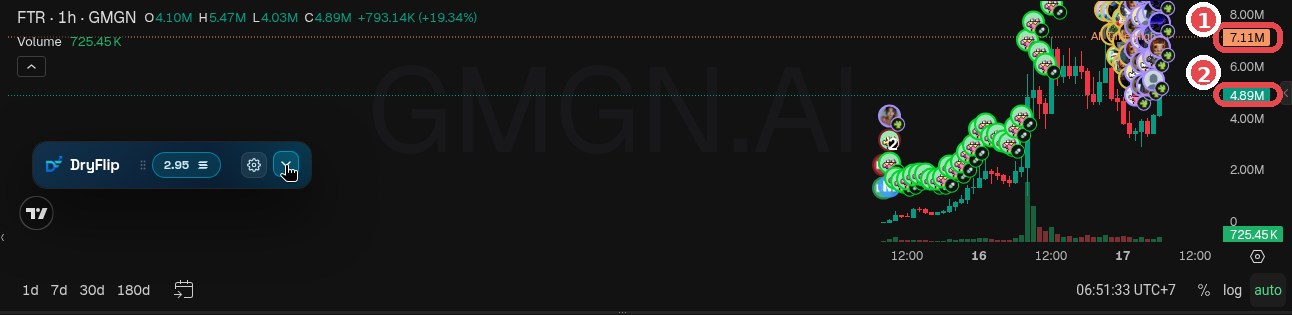
- Based on : set MC targets to sell part of your position.
- Based on danger signs: sell if the , , or big start dumping.
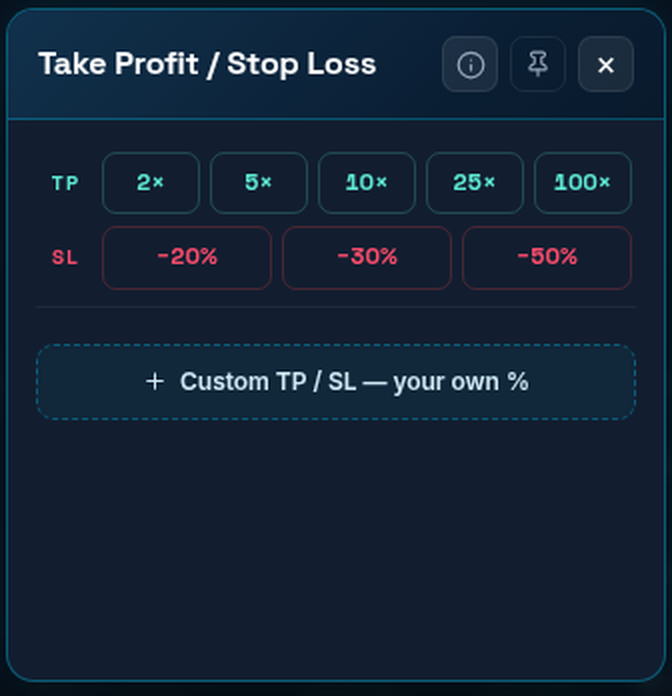
- Use automatic Take Profit in your terminal so you don't depend on emotion.
When to cut loss?
- When your reason for no longer holds, for example the dev starts selling or big holders exit.
- When the price hits the loss limit you set before buying.
- When there are signs of a rug or scam.
A small cut loss is the cost of learning. Waiting for it to "come back later" often ends with you as a .
RR Matters More Than WR
- WR () = what percentage of your trades are in profit.
- RR (risk/) = how much you're ready to lose vs how much you're aiming for in one trade. Example: ready to lose 20% for a 60% profit target = RR 1:3.
A high WR sounds cool, but what decides your balance is how big your wins are vs your losses. Illustration (made-up numbers for the example, 10 trades, the same 0.1 SOL per trade):
| Trader A | Trader B | |
|---|---|---|
| WR | 80% (8 wins, 2 losses) | 30% (3 wins, 7 losses) |
| Each win | +10% (+0.01 SOL) | +100% (+0.1 SOL) |
| Each loss | −50% (−0.05 SOL), cut loss too late | −15% (−0.015 SOL), disciplined cut loss |
| Result | +0.08 − 0.10 = −0.02 SOL | +0.30 − 0.105 = +0.195 SOL |
Trader A wins more often but is still down. Trader B loses more often but is in profit, because the losses are small and the profits are left to run. So: decide how much you're ready to lose and what your target is before entry.
Healthy habits
- Every trade has a TP and SL plan.
- Part of your profit gets moved out of your trading .
- Consistent position sizes, not going up and down with your mood.
Dangerous habits
- Going all-in on one token.
- Revenge trading after a loss with a bigger position.
- Never taking profit because you're hoping for a 100x.
- Moving your TP target again and again because of greed.
Summary
- Separate degen money, a limited size per trade, and a daily loss limit.
- Have a take profit and cut loss plan before you buy (take out initials, sell in stages, MC targets, or danger signs).
- RR matters more than WR: keep losses small and let profits run. This consistency is what keeps you in the game long enough.
Common mistakes
- Going all-in on one token, or revenge trading after a loss with a bigger position.
- Waiting for it to "come back later" until you're a bagholder.
- Moving your TP target again and again because of greed.
Next up, lesson 3.4: Trading Journal & Loss Review.
Not financial advice.
Progress is saved in this browser.