
Tech Tokens (ICM/Utility) vs Meme
Before Chapter 2 (checking a token's ), there's one question you have to answer first: is the token you're looking at a meme or tech? It sounds trivial, but you read them very differently. What makes the price go up is different, and so is what makes it . Guess the type wrong and your analysis can be off from the start.

Why do you need to tell them apart?
- A number that looks "good" on a meme doesn't necessarily mean the same thing on a tech token.
Example: big on a meme usually means the hype is running. On a tech token, big volume with no product users might just be traders flipping it. - A selling tokens is often seen as normal on a meme. On a tech token, it's more often a warning sign (lesson 2.5).
- If you play memes and tech without noticing the difference, it's hard to figure out what went wrong when you lose (lesson 3.1).
How to read this lesson: identify the type → know its good and bad signs → check it in the field in 1 to 2 minutes.
Quick definitions
- Meme / : a token whose price moves mostly because of story, community, and virality. The product is usually thin or nonexistent. (see also lesson 1.7)
Example: a token with a dog, frog, cat, political figure, or whatever trend is hot on X. - Tech / ICM / utility: a token whose claim is tied to technology or a use case. ICM = Internet Capital Markets, a way of saying "this token is like a stock in an internet product", not a pure meme.
Example: AI agents, infrastructure, trading tools, on-chain games, or protocols that need a token to run. - Gray zone: lots of tokens sit in the middle. Some have a meme logo but also a dashboard. Some claim to be tech but their website is a single empty page.
Example: what matters is that you know why you're buying. Is it the hype, or the product?
Quick comparison
| Aspect | Meme / memecoin | Tech / ICM / utility |
|---|---|---|
| What makes it go up | Virality, KOLs, story, timing | A working product, users, lock/vesting, a tech narrative |
| What makes it dump | Hype dies, KOLs exit, / leave | Dev walks away, big unlocks, the product fails, exposed as fake tech |
| What gets checked most | Community, chart, , talk on X | Website/repo, locked , team, real use |
| Lifespan of the "story" | Can be hours to days | Can be longer, but it can still die |
| Dev selling tokens | Often tolerated (depends on the situation) | More often a red flag (lesson 2.5) |
| Typical framing | "Dog with hat", politics, trending memes | AI agents, infra, tools, protocol fees |
Examples to make it clearer
Examples that usually belong in the meme pool
- BONK: dog branding + a big community. Its moves are usually talked about in terms of hype and virality, not because people "use BONK the product" every day.
- WIF (dogwifhat): the logo is a dog wearing a hat. The story is pure meme. When the hype on X goes quiet, the reason to hold it gets thin too.
- POPCAT: tied to a viral cat meme. The product behind it isn't the main point.
Quick way to spot one: a funny or absurd name/logo, a thin website, and people talk more about "the chart" and "the community" than about "features you can try".
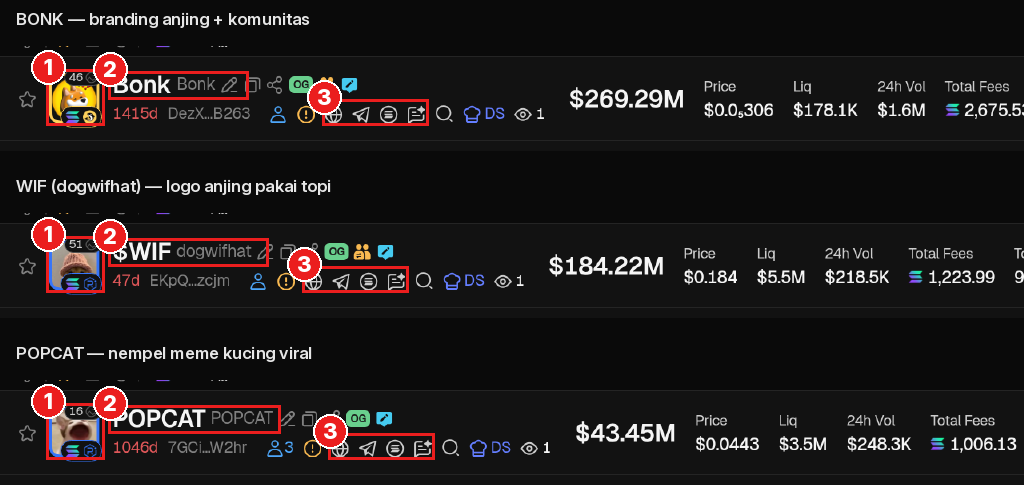
BONK / WIF / POPCAT on GMGN. ① Meme logo/branding. ② Ticker + name. ③ Website / Telegram / X icons in the header. The main framing is community and story, not a product used every day. GMGN screenshot (checked Oct 24, 2026 ~22:50 WIB, logged out); the numbers were live at the time and will keep changing. Tokens are only examples, not recommendations.
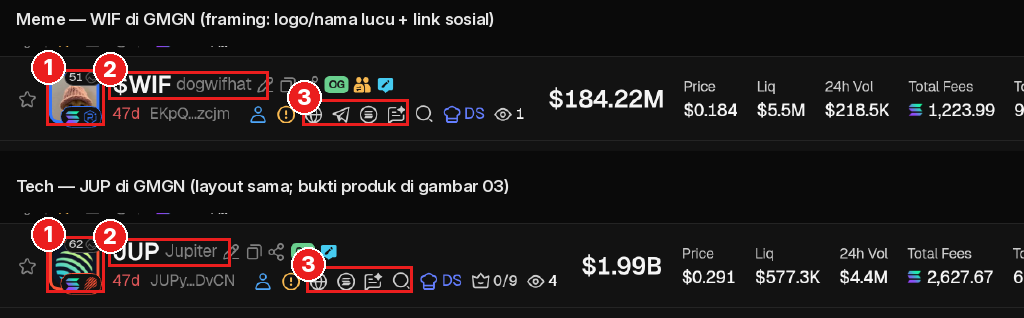
WIF (meme) vs JUP (tech) in GMGN headers with a similar layout. You can tell them apart by the branding and whether there's a real product you can open (see the site image below). GMGN screenshot (checked Oct 24, 2026 ~22:50 WIB, logged out). Tokens are only examples, not recommendations.
Examples that usually belong in the tech / ICM / utility pool
- JUP (Jupiter): people actually use Jupiter to swap (an aggregator) on Solana. The token is tied to a product you can open and use.
- PYTH: an oracle, a service that sends price data to the blockchain. Its use for other protocols is clear, not just a cute logo.
- RAY (Raydium): a and hub on Solana. There's a working trading product.
Quick way to spot one: there's a product you can open, clear docs/site, and people can explain "what this token is for" without saying "because it's viral".
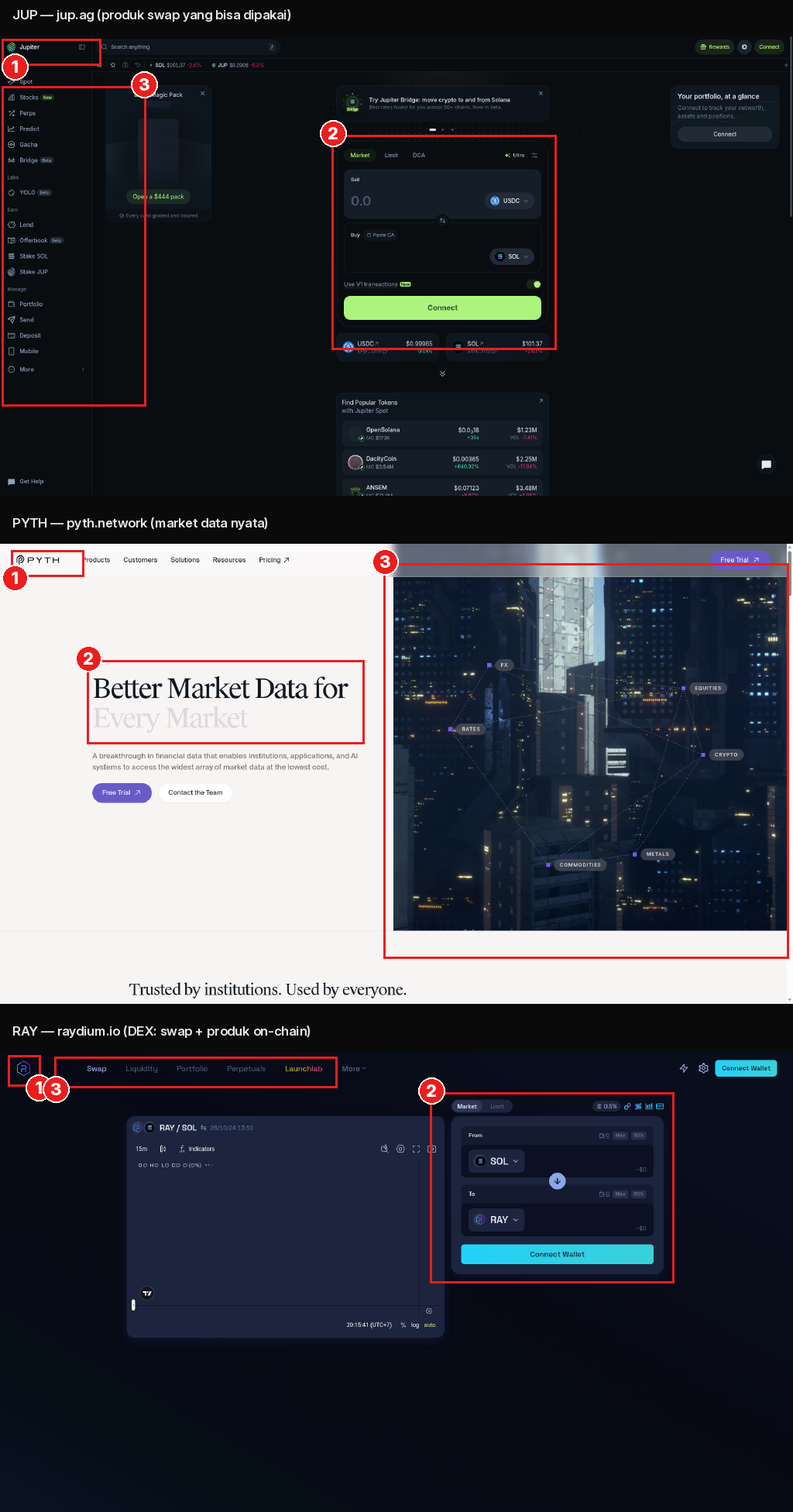
Proof of a tech product: jup.ag (swap), pyth.network (market data), raydium.io (DEX). ① Brand. ② Product UI you can try. ③ Nav/features. Compare with the meme pages above: here what's offered is a service. Site screenshots (checked Oct 24, 2026 ~22:50 WIB, logged out, no connected). Tokens are only examples, not recommendations.
Examples that often confuse people (gray zone)
- A token with AI / agent / ICM in its name and a slick website, but when you click the features it's just "coming soon" or an empty form.
Example: treat it like a risky meme until the product is proven. - A token with a cute mascot, but there's a dashboard or tool behind it that actually works.
Example: some meme flavor is fine, but still check the product, the locks, and the risks in Chapter 2.
Quick exercise: open GMGN or X, pick 1 random token, and ask yourself: "If the hype died tomorrow, what would still be attached to this token?" If the answer is "nothing", it behaves like a meme even if its name says tech.
Traits of meme tokens
What you usually see
- A funny, absurd, or trend-chasing name/logo (animals, public figures, meme formats).
- A thin website, or just an X + Telegram link. A whitepaper is rare, or it's a meme too.
- Talk on X/Telegram: "send it", "community take over", "we are early".
- A roadmap, if there is one, is usually a joke or empty. What counts is momentum, not promised features.
- Volume goes up because of hype, not because people actually use a product.
Green flags (good signs, meme context)
- An active community, not just spam bots.
Example: the group chat is busy with real conversation, not "LFG " repeated by brand-new accounts. - The story is still clear and hasn't gone stale.
- The Chapter 2 checks (, , ) don't show big risks.
- Mentions on X feel organic, not just bot replies.
Red flags (danger signs, meme context)
- Fake hype: bought likes/replies, a quiet group, a chart going up while the chat is dead.
- Extreme bundlers/snipers + top holders transferring to each other (lessons 2.7 to 2.9).
- A dev who often launches tokens and then rugs (lesson 2.5).
- A fake / (lesson 2.13).
Common ways to play it (not a recipe)
- Fast trades in the , buying on lowcaps, or following smart money, with small size and / rules (lessons 3.x).
- The main question: "is the story still alive?" That matters more than "the Q4 roadmap".
Traits of tech tokens (ICM / utility)
What you usually see
- Claims of a product: a bot, API, agent, dashboard, game, staking, fee share, and so on.
- A site, docs, or repo you can open (even if it's sometimes still early).
- Tokenomics often mention locks, vesting, a treasury, or what the token is used for (paying fees, feature access, governance).
- Talk on X is more about "ship", "users", "TVL", "integration", not just meme formats.
- The branding leans toward "product", although some tech tokens use a cute mascot too.
Green flags (good signs, tech context)
- Proof of usage: a live demo, a believable number of users, on-chain activity that connects to the product.
Example: you can try the feature yourself without waiting for "the next launch". - Important supply is locked, vesting is transparent, and the unlock schedule is clear.
- The deployer's history doesn't look like a serial rugger's.
- Docs/repo are still being updated recently, not abandoned long ago.
- The token is actually used for something, not just a "governance later" promise.
Red flags: fake tech / LARP
LARP means pretending. The token looks like a tech project, but there's nothing inside.
- A slick website, but clicking any feature = "coming soon" forever, or an empty form.
- "AI" in the name, but nothing you can check (an endpoint, an agent, or on-chain activity).
- A copy-pasted whitepaper and nice slides, but zero code and zero users.
- The dev sells or transfers a lot right after launch. On a tech token this is more suspicious (lesson 2.5).
- A big unlock with no explanation.
- Fake partnership claims or edited screenshots.
How to tell them apart in the field (1 to 2 minutes)
A practical order before you enter:
- Read the branding + X bio + website, 30 seconds. More meme, or more product?
- Look for proof of use. Is there a working product link? Can you try it? Are there fees or on-chain usage?
- Check lock / vesting / DEV on GMGN (lesson 2.5). On tech tokens, this matters more.
- Run the standard Chapter 2 risk checks (no mint, burnt, holders, sniper, bundler, etc.). Required for both meme and tech.
- Ask yourself: "If the hype on X died tomorrow, what would still be attached to this token?"
Example: you open a token called "XYZ AI Agent". The website looks great, but the "Try Agent" button only opens an email signup form. Result: treat it as a meme, and read it through a meme lens.
What trips people up
- Memes disguised as tech: an AI logo + a template website, but zero product. Analyze it like a meme. Don't give it a pass "because it's tech".
- Tech disguised as a meme: a cute mascot but a real product. You can play the narrative, but still check the locks and the product.
- ICM that's only branding: the word ICM on your timeline doesn't mean there's a product or revenue. Ask for proof first.
- Utility with no actual utility: "for governance" with no product is often just a label.
How this connects to your playstyle
Once you can tell them apart:
- Pick your pool: meme or tech/ICM/utility (lesson 3.1).
- Match your signal sources: for memes → community and timing. For tech → a working product and tokenomics. Both still get the Chapter 2 risk checks.
- Don't mix up your reviews: losing on a meme because the story died is different from misreading a tech token.
Summary
- Memes live on hype and community. Tech / ICM / utility (three names, one type) claims to be tied to a product or a use case.
- The traits, good/bad signs, and how much each metric weighs (especially dev selling and locks) are different for these two types.
- A tech label can be fake. Proof of product first, then trust the narrative.
- The Chapter 2 risk checks are still required for both types, and checks only measure risk, they don't predict the price.
Common mistakes
- Assuming anything with "AI / agent / ICM" in it is automatically tech and lower risk.
- Reading a tech token the way you read a meme, or the other way around.
- Skipping Chapter 2 because "it's utility, it must be solid".
- Panicking or relaxing in the wrong context when the dev sells, without telling meme from tech.
In the market, what we're after is the smallest possible risk. Tell the token type apart first, so the risk you take is a conscious choice, not a surprise.
Next up, lesson 2.1: No Mint. Start checking a token's risk before you buy.
Not financial advice. Every token in this lesson is only an educational example, not a recommendation.
Starter
· the badge unlocks when every lesson is done + quiz ≥ 70%.
- 1.1 When Am I Ready to Go Degen?
- 1.2 How to Demo Trade
- 1.3 Start Live Trading: Tools & Pintu Setup
- 1.4 Create a GMGN Wallet & Send SOL from Pintu
- 1.5 (Optional, but Recommended) Set Up Frontrun & Its Fees
- 1.6 How to Withdraw: From GMGN Back to Pintu
- 1.7 Must-Know Degen Terms
- 1.8 Tech Tokens (ICM/Utility) vs Meme
Progress is saved in this browser.